


Last Updated: October 23, 2026
Quick Summary
The best lubricant for painful intercourse is a fragrance-free water-based formula for most women, while a silicone-based lubricant suits extended activity or hormonal dryness. Apply generously to both the vulva and the penetrating object, and reapply at the first sign of drag. A lubricant for painful intercourse reduces friction only, so persistent pain needs evaluation.
- Water-based lubricant is the most versatile starting point and is safe with latex condoms.
- Silicone-based lubricant lasts longer but degrades silicone toys, so use water-based with those.
- Skip lubricants with fragrance, warming or tingling agents, and glycerin if you are yeast-prone.
- Apply a nickel-to-quarter-sized amount to the vulva and the object, then add more as needed.
- If pain continues with the right lube, the cause is likely muscular, inflammatory, or hormonal.
Table of Contents
- Why the Right Lubricant Matters for Painful Intercourse
- Water-Based vs Silicone-Based Lubricant: Which to Choose
- Lubricant Ingredients to Avoid if You're Sensitive
- Why Sex Hurts Even With Lube: Causes Beyond Dryness
- Pelvic Floor Therapy for Painful Intercourse
- Vaginal Dryness and Hormonal Changes: Matching Lube to Your Needs
- How to Use Lubricant and Troubleshoot Discomfort
- When a Lubricant Isn't Enough: VuVa Magnetic Dilators
- References & Further Reading
- Frequently Asked Questions
Why the Right Lubricant Matters for Painful Intercourse
Finding the best lubricant for painful intercourse starts with understanding what a lubricant for painful intercourse can and cannot fix. A personal lubricant reduces friction between skin and tissue during sexual activity.
I invented VuVa after my own struggle with vulvodynia, and one thing I've learned from talking with women over the years is that lube is often the first thing they try, and the first thing they blame when it doesn't work.
Research informing World Health Organization self-care guidance found that lubricant use, alongside pelvic-floor relaxation exercises and vaginal moisturizer, was associated with lower pain, according to a 2022 systematic review on lubricants for sexual health.
Water-Based vs Silicone-Based Lubricant: Which to Choose
Water-based lubricant is the most versatile starting point, while silicone-based lubricant lasts longer and needs less reapplication. The right choice depends on your body, your condom use, and how much friction you're trying to reduce. A pelvic-floor physical therapy guide notes that water-based formulas can be absorbed by tissue and may require reapplication, while silicone options stay slippery longer.
| Feature | Water-Based | Silicone-Based |
|---|---|---|
| Longevity | Shorter, needs reapplication | Long-lasting |
| Condom compatibility | Safe with latex | Not with silicone toys |
| Cleanup | Easy, water-soluble | Requires soap |
| Best for | Sensitivity, toy use | Extended intercourse, dryness |
Water-Based Options: Versatility and Easy Cleanup
Water-based lubricants are the safest default for most women, especially anyone new to lube or using latex condoms. GoodRx notes that water-based formulas do not damage latex and clean up with water alone.
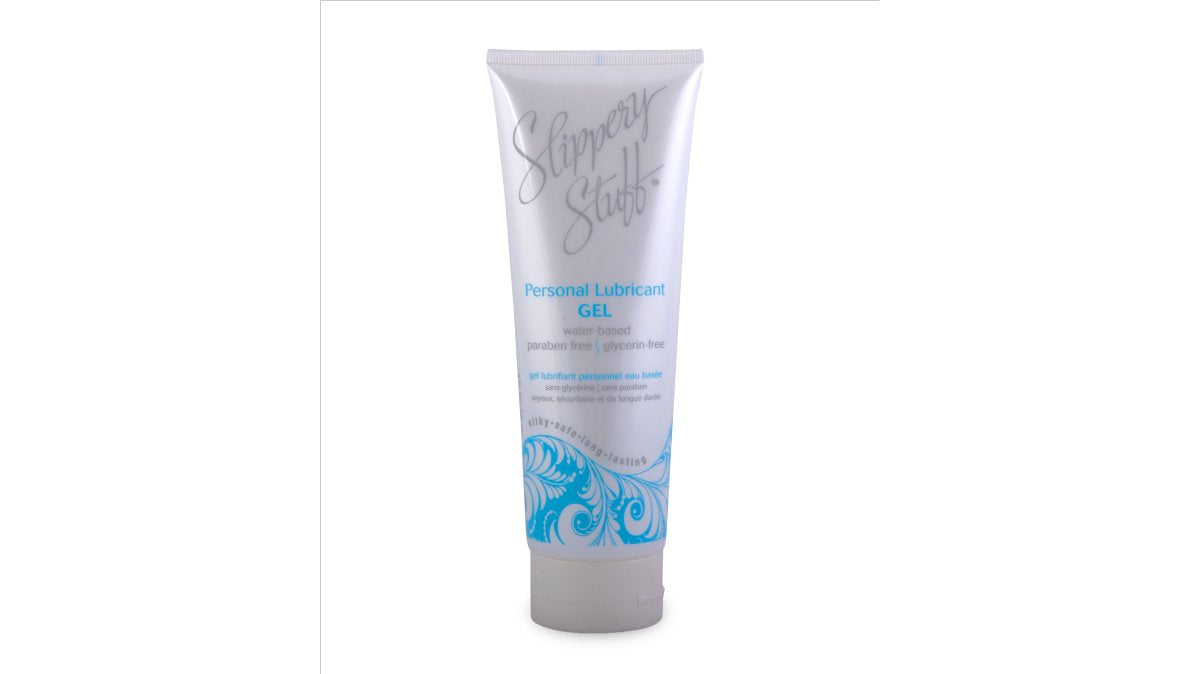
If you're leaning this direction, we carry a 4oz Slippery Stuff Gel Personal Lubricant that is water-based, odorless, and non-staining. A 2oz Slippery Stuff Gel Personal Lubricant is also available if you want to try before committing.


The limitation: water-based lube dries out. Keep it nearby and reapply as needed.
Silicone-Based Options: Long-Lasting Lubrication
Silicone-based lubricants are the better pick when you need lubrication to last through extended sexual activity without interruption. Lady Bird Physical Therapy describes silicone formulas as providing substantial lubrication that doesn't dry out during sex. The catch is cleanup and material compatibility: silicone lube requires soap and water and can degrade silicone sex toys, so use water-based with those.
Lubricant Ingredients to Avoid if You're Sensitive
Fragrance, warming agents, and high-osmolality formulas are the three ingredient categories most likely to irritate sensitive vaginal tissue. If your vulvovaginal discomfort flares after using a product, check the label before assuming the pain is unrelated. It isn't just what is in the bottle, it's how concentrated the formula is, vulvar skin is among the most sensitive on the body, so a product that feels fine on your hands can burn on irritated tissue.
The four things to screen for
1. Fragrance and flavoring. Added fragrance is one of the most common contact irritants in personal care products.
4oz Slippery Stuff Gel Personal Lubricant →
2. Warming, tingling, or cooling agents. These work by deliberately provoking a nerve response, that's the "sensation." For women with vulvodynia, vestibulodynia, or any inflamed tissue, that provocation is the opposite of what you want.
3. Glycerin and high-osmolality formulas. Some women find glycerin-containing lubricants contribute to yeast irritation. High-osmolality formulas can draw moisture out of vaginal tissue, which some clinicians associate with irritation.
4. pH mismatch. Healthy vaginal pH sits in the acidic range (roughly 3.8-4.5). A lubricant far outside that range may feel uncomfortable or disrupt the local environment.
A usable label-screening checklist
- No added fragrance, flavoring, or "parfum"
- No warming, tingling, cooling, or "stimulating" agents
- No glycerin if you're prone to yeast irritation
- Osmolality or pH noted, or a short, simple ingredient list
- Preservative listed clearly (paraben-free options exist)
- Few ingredients, all recognizable
Patch-test before you commit
If you're unsure whether a formula will agree with you, apply a small amount to the inner forearm or outer vulva and wait 24 hours before using it internally. It isn't a perfect test, but it catches the obvious reactors. When I talk with women who've been through a string of "sensitive" formulas that still burned, the answer is usually a simpler product, not a fancier one.
If you've screened your lubricant and discomfort persists, that's a signal to look beyond the bottle.
Why Sex Hurts Even With Lube: Causes Beyond Dryness
Lube doesn't fix pain that isn't caused by friction. If intercourse still hurts after you've found a lubricant that works, the cause is likely muscular, inflammatory, or hormonal rather than simple dryness. Common causes include pelvic floor tension, vaginismus, vulvodynia, and hormonal tissue changes.
One question women frequently ask me is whether they're "doing lube wrong." If you've wondered does lube help with tightness, the answer depends on what's causing the pain. Almost never. They're using the right product for a problem it wasn't designed to solve.
Pelvic Floor Therapy for Painful Intercourse
Pelvic floor physical therapy addresses the muscular causes of painful intercourse, which lubrication cannot reach. A trained therapist assesses tension, trigger points, and coordination, then teaches relaxation and stretching techniques. If your pelvic floor stays tight during penetration, no amount of lubricant will override that guarding response.
For a closer look at how therapy fits into a broader plan.
Vaginal Dryness and Hormonal Changes: Matching Lube to Your Needs
Menopause and perimenopause change vaginal tissue, calling for a different lubricant strategy. As estrogen declines, tissue thins and natural lubrication decreases, which is why a product that worked at 30 may feel inadequate at 50. For hormonal dryness, silicone-based lubricant often performs better because it doesn't absorb into tissue as quickly. Bethany Hansen PT lists silicone- or oil-based lubricants as possible options during hormonal changes. Pairing lube with a vaginal moisturizer addresses both immediate friction and ongoing tissue hydration. Oil-based lubricants are an option too, but they damage latex condoms and leave residue.
How to Use Lubricant and Troubleshoot Discomfort
Apply lubricant generously to both the vulva and the penetrating object, and reapply before it dries rather than after discomfort starts. Most discomfort traces back to too little product, applied too late.
How much, and where
A common mistake is treating lubricant like lotion, a dab here and there. Most practitioners suggest a nickel-to-quarter-sized amount on the vulva and a similar amount on the penetrating object, then adding more as needed. Apply to the entrance of the vagina and along the vulva, not just the object, because friction happens at the tissue.
4oz Slippery Stuff Gel Personal Lubricant →
Timing and reapplication
Water-based formulas absorb and evaporate, so plan to reapply every few minutes during extended activity. Silicone-based formulas last longer but still benefit from a top-up if you feel drag. The signal to reapply is drag, that slight catching sensation, not pain.
Compatibility at a glance
| Lubricant base | Latex condoms | Polyurethane condoms | Silicone toys | Cleanup |
|---|---|---|---|---|
| Water-based | Compatible | Compatible | Compatible | Water alone |
| Silicone-based | Compatible | Compatible | Avoid, degrades silicone | Soap and water |
| Oil-based | Avoid, weakens latex | Generally compatible | Compatible | Soap and water; residue |
Troubleshooting a failed attempt
A few troubleshooting steps:
- Start with more lubricant than you think you need. Under-application is the most common cause of "lube didn't work."
- Pause and reapply at the first sign of drag, not after it starts to sting.
- Try a different base if irritation persists, if water-based burns, a fragrance-free silicone formula may suit you better, and vice versa.
- Slow down and add relaxation breathing before penetration. A tense pelvic floor can override even a well-lubricated attempt.
- Stop if it burns. Burning is not a normal part of "getting used to" a lubricant.
When lube isn't the whole answer
If you've tried the right amount, the right base, and the right timing and penetration still hurts, the problem likely isn't the lubricant.
This is exactly why I created VuVa Magnetic Dilators: a home-based option for women whose pain comes from pelvic floor tightness rather than dryness alone.
How to choose your set: start with the smallest size you can insert comfortably, not the size you hope to reach. If lube isn't enough, a structured routine can be explored, and techniques that work alongside lubricant can be helpful.
Explore our magnetic dilator collection to find your starting size. Dilators are one part of a broader care plan, so talk with your doctor or pelvic floor therapist before starting.
When a Lubricant Isn't Enough: VuVa Magnetic Dilators
Painful intercourse rarely has a single fix, and lubricant is one piece of the puzzle. If you've tried every formula and still dread intimacy, VuVa Magnetic Dilators offer a home-based routine built around gradual stretching and our patented neodymium magnet design. Our sets are made in the USA with medical-grade BPA-free plastic and backed by a 10-year magnet strength warranty. Explore VuVa Magnetic Dilators and find the set that matches where you are right now.
References & Further Reading
- Kennedy CE and coauthors. Lubricants for the promotion of sexual health and well-being: a systematic review informing WHO self-care guidance, 2022. https://pmc.ncbi.nlm.nih.gov/articles/PMC8942543/
- Contemporary OB/GYN. "Efficacy and safety of water-based personal lubricants."
- Foundations Pelvic Health. "A Pelvic Floor PT's Guide to Choosing the Right Lubricant."
- GoodRx. "What's the Best Lubricant for Vaginal Dryness?"
- American College of Obstetricians and Gynecologists (ACOG). Patient guidance on painful intercourse and vaginal dryness.
Note: The research cited above concerns lubricant therapy generally. VuVa's patented magnetic design is a separate product feature and has not been compared against non-magnetic dilators in a head-to-head clinical trial.
Frequently Asked Questions
Does lube help with painful intercourse?
It often does, especially when dryness and friction are part of the problem. A 2022 review informing WHO self-care guidance reported that lubricant use, alongside pelvic-floor relaxation exercises and vaginal moisturizer, was associated with lower pain. That does not prove lubricant alone fixes pain, and the review summary gives no sample size. Think of a good lubricant as one practical step: it reduces friction on sensitive vaginal tissue, but if pain continues, the cause may sit deeper than dryness and deserves a proper evaluation.
Why does intercourse hurt even with lube?
Lubricant addresses friction, not every cause of dyspareunia. Pain can come from pelvic floor tension, vulvodynia, hormonal changes, infection, or a skin condition, and those need their own care. A lubricant also may not be the right type for you: one that dries quickly or contains an irritating ingredient can leave you uncomfortable. If pain is new, persistent, or comes with bleeding or discharge, see a healthcare professional rather than trying more products.
Can lubricant cause vaginal irritation?
Yes, for some women. Ingredients like fragrance, warming agents, and certain preservatives are common culprits, and osmolality (how concentrated a formula is) can matter too. Try a fragrance-free, water-based formula first, patch test on your inner arm, and stop if you notice burning or itching. If irritation persists, ask your gynecologist whether a silicone-based option or a vaginal moisturizer suits your situation better.
Which type of lubricant is best for vaginal dryness?
It depends on how you're using it. Water-based lubricants are versatile, compatible with latex condoms, and easy to clean up, though they can be absorbed and need reapplication. Silicone-based lubricants stay slippery longer and don't dry out during sex, which pelvic-health sources often suggest when longer-lasting lubrication is wanted. Pairing a lubricant with a vaginal moisturizer for ongoing hydration is another option worth discussing with your doctor.


