


Last Updated: November 15, 2026
Quick Summary
P2 usually refers to the second size in a graduated dilator set, the step many people reach after starting with the smallest option. In a progressive dilation routine, P2 is the first size that asks the tissue to stretch rather than simply accept, so it is a milestone rather than a target to rush toward.
- P1 is the entry size, often close to a tampon or finger in diameter, and P2 is the next step.
- Stay at a size until it feels easy, sometimes for weeks, before moving on.
- Signs you are ready to move past P2 include easy insertion, no clenching, and no soreness afterward.
- VuVa Sizes 1-4 are the smaller beginner progression, best for most people starting out.
- Size 1 contains no magnet, even when it is sold inside a magnetic set.
Table of Contents
- Why the Term P2 Can Be Confusing
- What Does P2 Stand For in Pelvic Health?
- The Meaning of P2 in a Progressive Dilation Routine
- How to Read P2 Search Results and Find Reliable Information
- Which VuVa Magnetic Dilator Set Should You Start With?
- How a P2 Dilator Fits into a Comfortable Routine
- Finding Your Comfortable Starting Point with VuVa
- Frequently Asked Questions
Why the Term P2 Can Be Confusing
If you searched for "P2" and landed on unrelated results, you are not alone. The term P2 is genuinely ambiguous, and that ambiguity is the first thing worth clearing up. In pelvic health, P2 is shorthand for a specific step in a progressive dilation routine, not a math problem.
I created VuVa in 2014 after years of my own painful intimacy, and I have since heard from many people who were handed an image of the purple wand: it is set with almost no explanation of what the sizes meant. That silence is where confusion grows.
Here is the short answer: P2 usually refers to the second size in a graduated dilator set, the one many people reach after starting with the smallest option. Below, I will explain what P2 stands for, how it fits into a progressive routine, and how to read search results without getting lost.
What Does P2 Stand For in Pelvic Health?
P2 stands for the second size, or "point two," in a graduated dilator progression. In most dilation routines, sizes are numbered from smallest to largest, and P2 is the step just after the starting size.
Dilation itself is a gentle, gradual stretching practice used as one part of care for conditions like vaginismus, vulvodynia, and menopause-related vaginal changes. A clinician or pelvic floor physical therapist often recommends it alongside other support, not instead of it.
The naming varies by maker, which is part of the confusion. Some sets use numbers, some use letters, and some use diameters. What matters is not the label but where that size sits in your own progression. For a fuller explanation of the term and why it matters, see our guide on what P2 stands for and why it matters for pelvic health.
The Meaning of P2 in a Progressive Dilation Routine
In a progressive routine, P2 is a milestone, not a target to rush toward. The goal of dilation is comfortable, sustained stretching over time, and each size exists to prepare the tissue gently for the next.
So what actually separates P2 from P1 and P3? In most graduated sets, P1 is the entry size, often close to a tampon or a finger in diameter, and its job is to help you get comfortable with insertion itself.
A common mistake is treating P2 as a level to "beat." In practice, the people who progress most comfortably are the ones who stay at a size until it feels easy, sometimes for weeks, before moving on. Discomfort that feels like stretching is different from pain that makes you tense up.
How do you know you are ready to move past P2? Most pelvic health practitioners look for a few signs rather than a calendar: the size goes in without hesitation, you can leave it in place for the full session without clenching, and you are not sore afterward.
If you are coming from a set where the smallest size felt manageable, P2 is typically the next step. If the smallest size still feels like too much, stay there. There is no schedule you are falling behind on.
For a deeper look at what this size means step by step, read our article on what P2 means in your progression.
How to Read P2 Search Results and Find Reliable Information
Search results for P2 are noisy, and the meaning of P2 depends heavily on context. A search engine cannot tell whether you mean an image of the purple wand: it is size, a film, or a statistical value, so it shows a mix.
A practical approach is to add context words to your search. Try "P2 dilator size," "P2 dilation progression," or "P2 pelvic floor" instead of the bare term. That single change filters out most of the unrelated results.
When you land on a page, check three things: does it name a real clinician or source, does it explain that dilation is one part of care rather than a cure, and does it avoid promising guaranteed results. Pages that skip all three are worth closing.
Watch out: some results describe a size using a measurement that does not match your own set. Always compare against the size chart that came with your dilators, not a number from an unrelated page.
Which VuVa Magnetic Dilator Set Should You Start With?
The right set depends on where you are starting, not where you hope to be. VuVa Magnetic Dilators come in progressive sizes, and the sets are organized to give you a comfortable range to work through.
- Sizes 1-4: a smaller beginner progression, best for most people starting out
- Sizes 3-6: an intermediate progression, for those who have already worked with smaller sizes
- Sizes 5-7: a larger progression, for people further along in their routine
- Full Set 1-7: the broadest range, for anyone who wants room to progress without ordering again
One detail worth knowing: Size 1 contains no magnet, even when it is sold inside a magnetic set. The magnetic design begins with the larger sizes in the set. That is simply how the progression is built.
Start with the smallest size you can use comfortably, and never force insertion. If you are unsure, the smaller beginner progression is the safer place to begin. You can compare options in our guide to the best dilator sets for pelvic floor use, and check exact dimensions on the VuVa dilator size chart. You can browse the full magnetic vaginal dilator collection when you are ready.
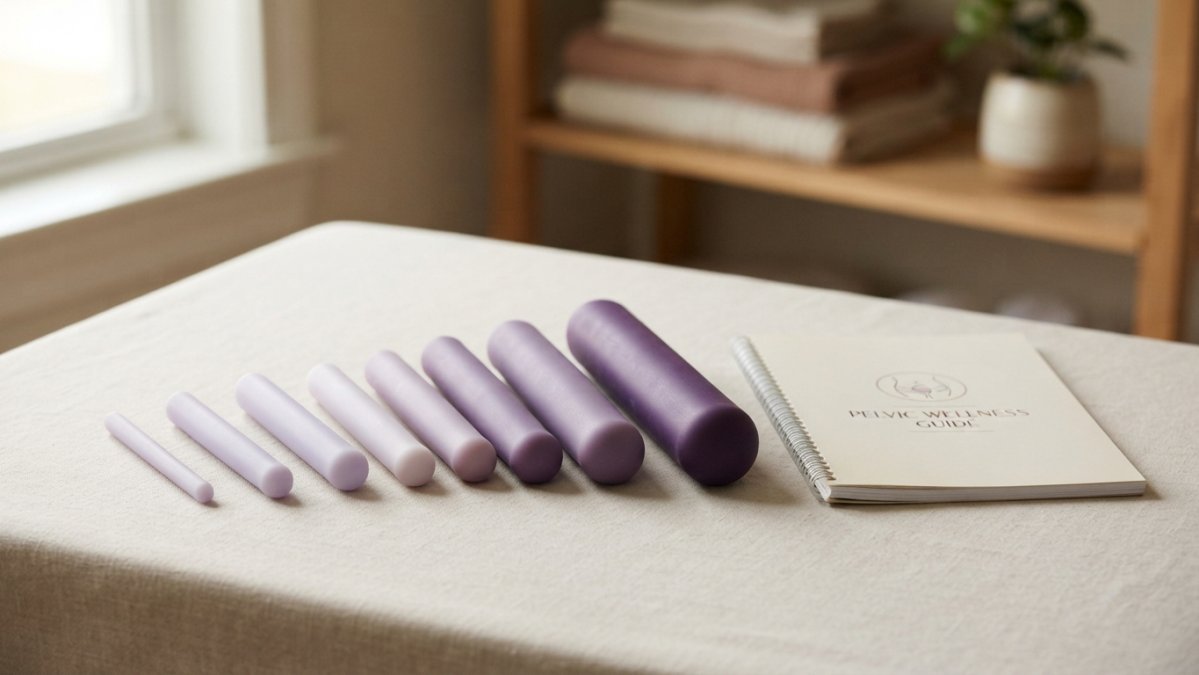
VuVa Magnetic Dilators come in progressive sizes, and the right set depends on where you are starting.
| Set | Best for | Note |
|---|---|---|
| Sizes 1-4 | Smaller beginner progression, most people starting out | Size 1 contains no magnet |
| Sizes 3-6 | Intermediate progression, after smaller sizes | Magnetic design begins with larger sizes |
| Sizes 5-7 | Larger progression, further along in routine | For people further along |
| Full Set 1-7 | Broadest range, room to progress without reordering | Size 1 contains no magnet |
How a P2 Dilator Fits into a Comfortable Routine
A P2 dilator fits into a routine as a short, regular practice, not a long session. Many people find that a few calm minutes several times a week works better than one longer, tense attempt.
Before you start. Empty your bladder first, a full bladder makes pelvic floor muscles harder to relax. Set a timer for five to ten minutes so you are not watching the clock.
Position. Lying on your back with knees bent and supported is the most common starting position because it lets gravity work with you rather than against you. Some people prefer lying on their side.
Insertion. Apply lubricant to both the dilator and the opening. Aim slightly toward the lower back rather than straight up, the vaginal canal angles that way, and aiming straight up is one of the most common reasons insertion feels blocked.
During. Leave the dilator in place and let the tissue adjust. You are not thrusting; you are allowing a gentle, sustained stretch.
After. Note how it felt, a simple one-line log is enough. Patterns show up over weeks that you will not notice day to day.
Watch out: if insertion burns, stings, or feels like tearing rather than pressure, stop for the day. That distinction matters, because burning and tearing can point to dryness, irritation, or a skin condition that needs a clinician's eye rather than more stretching.
A simple routine looks like this:
- Set aside a time when you will not be rushed
- Empty your bladder and warm the room
- Relax your shoulders and jaw before you begin
- Use enough lubricant, and add more if there is any drag
- Aim slightly toward the lower back, and breathe out on insertion
- Insert only as far as feels comfortable, and stop at sharp pain
- Note how it felt, so you can see progress over weeks
The magnetic design is a distinguishing feature of VuVa, not a promise of a different outcome. If you are using a magnetic dilator, choose a lubricant that suits both your body and the product, and read our guidance on silicone lubricant mistakes to avoid with magnetic dilators before your first session. You can read more about the benefits of magnetic pelvic floor dilators if you want the design details.
Finding Your Comfortable Starting Point with VuVa
The most useful thing you can do is start smaller than you think you need to. P2 will still be there when your body is ready for it, and there is no prize for arriving early.
If you have unexplained bleeding, signs of infection, sharp pain, or irritation that does not settle, please see a clinician before continuing. Dilation is one part of care, and a proper assessment matters.
I built VuVa because I remember how frightening it was to face painful insertion with no clear guidance. Our patented, permanently enclosed neodymium magnets, progressive sizing, and discreet shipping are there to make the routine easier to start and easier to continue. VuVa Magnetic Dilators are HSA/FSA eligible, made in the USA, and covered by a 10-year magnet strength warranty.
Not sure where to start? Explore VuVa Magnetic Dilator sets and find a comfortable starting size.
Medical References
- American College of Obstetricians and Gynecologists. ACOG patient guidance on painful intercourse
- National Library of Medicine, PubMed. peer-reviewed research on vaginismus and dilator therapy
- International Society for the Study of Vulvovaginal Disease. ISSVD terminology and vulvodynia resources
- National Health Service. NHS guidance on pelvic floor exercises and vaginal changes
About the Author
Tara Langdale is the founder and inventor of VuVa. She created VuVa in 2014 after personally experiencing vulvodynia and painful intimacy, and has since worked to make gentle, well-explained pelvic wellness tools available for home use.
Frequently Asked Questions
What does P2 stand for?
In pelvic health, P2 is not a standard medical abbreviation. It most often appears as shorthand for a second-level size in a progressive dilation set. Some people use it to mean 'phase 2' of a routine. Because the term is ambiguous, it is always best to check the context. If you see P2 in a product guide, it likely refers to a specific dilator size, not a diagnosis or treatment stage.
Is a P2 dilator the right size for a beginner?
A P2 dilator is generally not a beginner size. Most progressive sets start with a smaller size, often labeled P1 or Size 1. For a comfortable start, choose the smallest dilator you can insert without force. In the VuVa Magnetic Dilator sets, Size 1 has no magnet and is the smallest option. If you are new to dilation, start there and only move to a P2 or larger size when you feel ready.
How can I tell which meaning of P2 someone is searching for?
You can often tell by the context of the search. If the search includes words like 'dilator,' 'pelvic floor,' or 'vaginismus,' P2 likely refers to an image of the purple wand: it is size. If it refers to something unrelated to pelvic health, it likely means something else entirely. For pelvic health questions, add terms like 'dilator sizing' or 'pelvic therapy' to your search to get more relevant results.
What should I do if a P2 dilator feels uncomfortable?
If a P2 dilator feels uncomfortable, stop and go back to a smaller size. Never force insertion. Discomfort can be a sign that your pelvic floor muscles are not ready for that size yet. Try again another day with the smaller dilator, and use plenty of lubricant. If pain persists or you have concerns, speak with your doctor or a pelvic floor physical therapist for guidance.


