



Last Updated: November 13, 2026
Quick Summary
P2 meaning depends entirely on context: in pelvic health it usually refers to the second size in a graduated dilator set, while in business it signals a priority level and in automotive diagnostics it is a response-timing parameter. P2 is not a diagnosis and not a single fixed term, so the field using it determines what it means.
- In priority systems, P1 is the highest tier, P2 is important but not critical, and P3 is moderate.
- P2 in UDS diagnostics is the default response window, while P2 is the extended window after a response-pending message.
- In dilation, P2 is the step after the smallest dilator, and you should move up only when the current size feels comfortable.
- VuVa sizes 1 through 4 form a smaller beginner progression, and Size 1 contains no magnet even in a magnetic set.
- VuVa magnetic dilators use patented, permanently enclosed neodymium magnets and come in progressive sizes.
Table of Contents
- What Does P2 Mean? A Quick Answer Before We Go Deeper
- The P2 Medical Meaning: What It Refers to in Clinical Contexts
- P1 P2 P3 Meaning: How Priority Levels Work Across Industries
- P2 UDS Protocol: What It Means in Automotive Diagnostics
- How P2 Relates to Pelvic Health and Dilator Progression
- Which VuVa Magnetic Dilator Set Should You Start With?
- Finding Your Starting Point with VuVa Magnetic Dilators
- Frequently Asked Questions
What Does P2 Mean? A Quick Answer Before We Go Deeper
P2 is an abbreviation with several meanings depending on context, and in pelvic health it most often refers to a second-stage dilator size in a progressive dilation routine. I'm Tara Langdale, founder of VuVatech, and I created our magnetic dilator line in 2014 after my own years of living with vulvodynia and painful intimacy. When someone searches "p2 meaning," they are usually trying to decode a term they encountered in a medical note, a software manual, a car diagnostic report, or a product size chart. Below, I'll walk through each common meaning so you can identify which one applies to your situation, and I'll explain how the P2 concept fits into gentle, paced dilation.
The short version: P2 is not a diagnosis and not a single fixed term. It is a label whose meaning comes entirely from the field using it. In clinical settings, P2 can appear in staging or grading shorthand. In business, it signals a priority level. In automotive diagnostics, P2 refers to a specific protocol timer. And in dilator sizing, P2 usually means the second size in a graduated set. Context is everything.
The P2 Medical Meaning: What It Refers to in Clinical Contexts
There is no single P2 medical meaning, and that is the most honest thing I can tell you. In clinical shorthand, P2 is a context-dependent label, and the same two characters can point to different things depending on the specialty, the form, and the country the note was written in.
A few patterns come up often enough to be worth knowing. Medical shorthand conventions vary by institution, so the only reliable interpretation is the one the author intended in that specific record.
If you are reading your own chart and feel unsure, that uncertainty is normal. Medical shorthand is written for other clinicians, not for patients. Ask for a plain-language explanation at your next visit, and request that any abbreviation be spelled out.
Here is the practical distinction I want you to hold onto: a P2 label in a medical note is administrative shorthand, while a P2 label on an image of the purple wand: it is size chart is a product progression step. They share two characters and nothing else.

If painful penetration is what brought you here, the medical shorthand matters far less than the symptom. If muscle tightness or spasming is part of your experience, this look at pelvic floor muscle twitches goes deeper into that specific cause.
P1 P2 P3 Meaning: How Priority Levels Work Across Industries
The P1 P2 P3 meaning is simpler than it looks: these are priority levels, ranked from most urgent to least urgent. In product development, engineering, and support teams, P1 usually means the highest-priority item, P2 the next tier down, and P3 lower still. The same convention shows up in project management, incident response, and manufacturing planning. A P2 item is important but not an emergency; it gets scheduled ahead of routine work but behind anything flagged P1.
| Priority | Typical Urgency | Common Use | Response Pattern |
|---|---|---|---|
| P1 | Highest | Critical fixes, urgent incidents | Addressed first, often immediately |
| P2 | High but not critical | Important work with some flexibility | Scheduled ahead of routine tasks |
| P3 | Moderate | Standard improvements | Handled in normal queue |
| P4 | Low | Nice-to-have items | Addressed when capacity allows |
This tiering exists because teams cannot treat everything as equally urgent. The P1 P2 P3 meaning is essentially a shared language for triage. If you work in a setting where these labels appear, the practical takeaway is to confirm what your organization assigns to each tier, since definitions vary by team.
P2 UDS Protocol: What It Means in Automotive Diagnostics
P2 in Unified Diagnostic Services (UDS) is a response-timing parameter, not a fault code. When a diagnostic tester sends a request to a control module, P2 defines how long the tester waits for the module's initial response before it treats the request as unanswered. It is one of the timers that keeps diagnostic communication orderly, and it is defined in the ISO 14229 series that standardizes UDS.
There are two timers worth separating, because technicians often blur them together:
- P2 is the default response window. It governs the wait for the module's first reply to a request.
- P2* (often written P2 star) is the extended window. It applies after the module has already sent a "response pending" message, telling the tester it needs more time. The tester then waits the longer P2* interval instead of the shorter default.
That two-stage design exists because some operations genuinely take longer than the default window, such as routines that read or write memory, run an actuator test, or perform a longer self-check. Without the extended timer, a tester would abandon a perfectly healthy request and log a timeout.
For technicians, the practical point is that P2 settings affect how diagnostic software behaves. If a module is slow to respond, an incorrectly short P2 timer can produce false timeouts and misleading error codes. A common pattern is a tester configured with an aggressive default window against a module that is busy with another routine, which looks like a communication fault but is really a timing mismatch.
Do not read a P2 timeout as proof that the module is dead. Confirm the tester's timing configuration and whether the module sent a response-pending message before assuming a hardware fault.
One more distinction that trips people up: P2 in UDS is unrelated to the P2 priority tier used in software teams, and unrelated to the P2 size step on an image of the purple wand: it is chart. Same label, three different worlds.
How P2 Relates to Pelvic Health and Dilator Progression
In the context of dilation, P2 usually refers to the second size in a graduated set, the step after the smallest dilator. Gradual dilation is a paced stretching routine that some people use as one part of care for painful insertion, moving at a pace set by comfort rather than forcing progress. Moving through sizes slowly, only when the current size feels comfortable, is generally the safer approach than rushing toward a particular number.
Painful penetration has multiple possible causes, including genitourinary syndrome of menopause, involuntary pelvic floor tightening, vulvodynia, skin conditions, and infection. Dilation may sit alongside clinical assessment, pelvic floor physical therapy, lubrication or moisturizers, and clinician-prescribed menopause treatments. It does not replace medical care, and it is not a cure. If you want to understand how magnetic dilators are designed and what they can and cannot do, our article on the benefits of magnetic pelvic floor dilators explains the design and its limits. If muscle tightness or spasming is part of your experience, this look at pelvic floor muscle twitches goes deeper into that specific cause.
VuVa magnetic dilators use patented, permanently enclosed neodymium magnets and come in progressive sizes, which supports a carefully paced routine. Conventional non-magnetic dilators also provide mechanical stretching; the magnetic design is a distinguishing product feature, not a proven superior treatment. People with implanted electronic medical devices should check with their clinician before using a magnetic product.
Which VuVa Magnetic Dilator Set Should You Start With?
Choosing a set comes down to the range of sizes you may need over time. Sizes 1 through 4 form a smaller beginner progression, 3 through 6 suit an intermediate range, and 5 through 7 cover a larger progression. The Full Set 1 through 7 offers the broadest range if you are unsure how far your routine will go. Start with the smallest size that can be used comfortably, and never force insertion. Size 1 contains no magnet, even when it is sold within a magnetic set. For a closer look at how the kits compare, see which medical grade pelvic dilator kit to buy, and check the VuVa dilator size charts for exact measurements.
Finding Your Starting Point with VuVa Magnetic Dilators
The best starting point is the smallest size you can use without pain, and that may well be Size 1. If you are beginning at the very start of a progression, the Size 1 and 2 neodymium magnetic vaginal combo set pairs the non-magnetic first size with the smallest magnetic size, so you can build comfort before adding magnetic sizing. Move up only when the current size feels easy and comfortable, and pause or step back if you feel sharp pain, burning, or significant discomfort. Unexplained bleeding, signs of infection, or persistent irritation should be evaluated by a clinician before you continue.
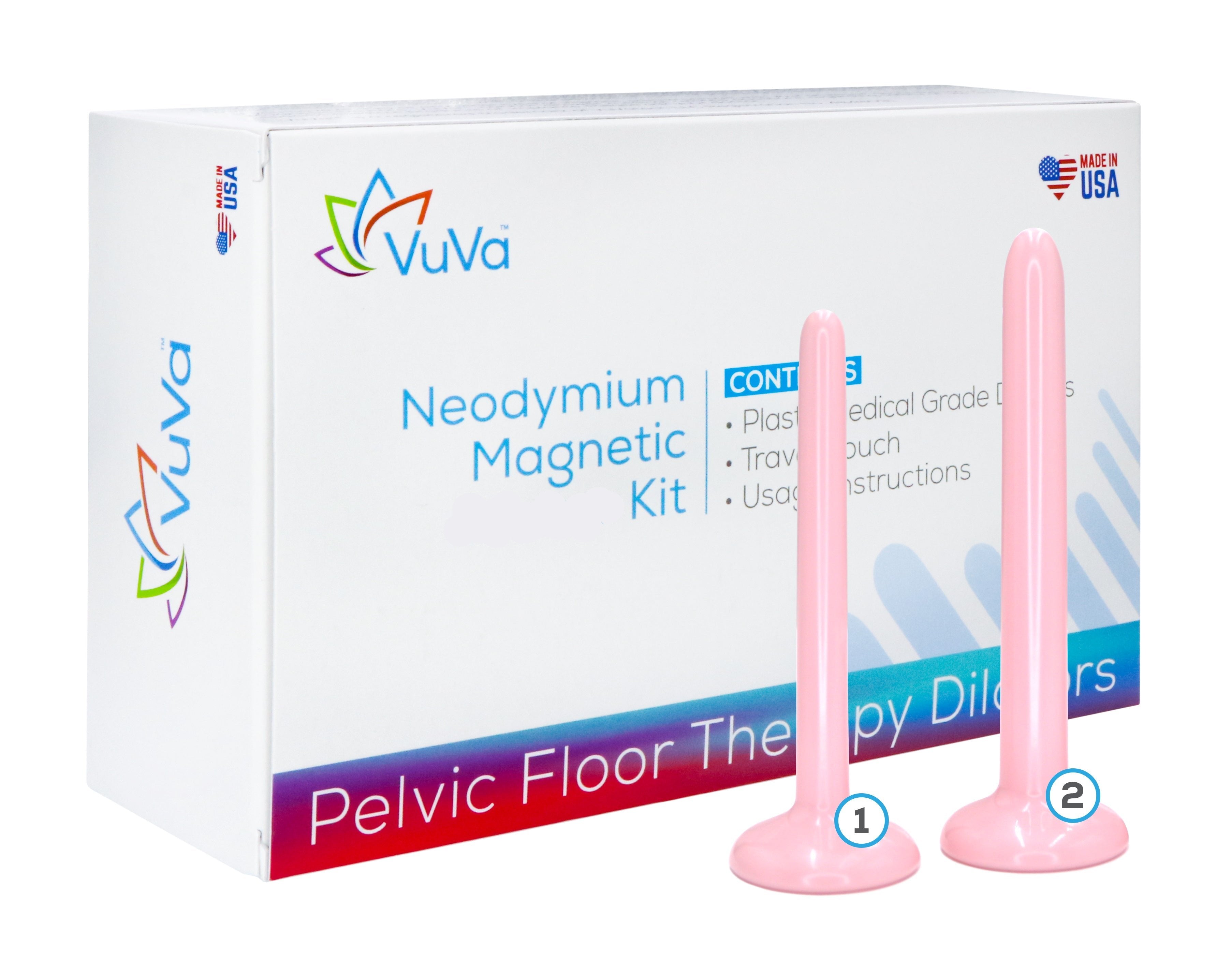
VuVatech has been in business since 2014, and our products are made in the USA with medical grade BPA-free plastic and discreet shipping. We recommend exploring our magnetic vaginal dilator collection at your own pace, and treating dilation as one part of a broader care plan shaped with your clinician.
Painful insertion is isolating, and it is easy to assume nothing will help after a long stretch of discomfort. If you are ready to begin a gentle, paced routine at home, VuVatech offers patented magnetic dilator sets in progressive sizes, medical-grade BPA-free construction, and a 10-year magnet strength warranty, all shipped discreetly. Get started with VuVatech and find a comfortable starting size for your own pace.
Frequently Asked Questions
What does P2 stand for?
P2 is an abbreviation with several meanings depending on context. In technology, it can refer to a priority level (second-highest after P1). In automotive diagnostics, P2 is a timer within the Unified Diagnostic Services (UDS) protocol that measures how quickly a vehicle module responds to a request. In medical settings, P2 may appear as a shorthand in clinical notes or as part of a classification system, though its exact meaning varies by institution. Always check the surrounding context to determine which P2 applies.
What does P2 mean in medical terms?
The P2 medical meaning is not a single standardized term. In some clinical documentation, P2 might indicate a priority level for triage or a phase in a treatment protocol. It can also appear in research as a label for a patient group or a measurement point. Because it is not a universal medical abbreviation, its interpretation depends on the specific healthcare setting. If you see P2 in your medical records, ask your provider to clarify what it refers to in your case.
What is P2 in the UDS protocol?
In the Unified Diagnostic Services (UDS) protocol used in automotive diagnostics, P2 is a timer that defines the maximum time a server (vehicle module) has to respond to a diagnostic request. It is typically measured in milliseconds and ensures that diagnostic tools can detect unresponsive modules. A related timer, P2*, extends the window when the server sends a negative response indicating it needs more time. These timers help maintain reliable communication between diagnostic equipment and vehicle systems.
How do I know which VuVa Magnetic Dilator size to start with?
Start with the smallest size you can use comfortably without forcing insertion. VuVa sets are organized by progression: Sizes 1-4 are smaller beginner sizes, 3-6 are intermediate, and 5-7 are larger. The Full Set 1-7 offers the broadest range. If you are new to dilation, the 1-4 set is often a good starting point. Remember that Size 1 contains no magnet, even when sold in a magnetic set. You can view the full size guide at vuvatech.com/pages/vuva-dilator-size-charts to compare options.


