


Table of Contents
- What Does Vaginismus Feel Like? The Sensations Women Describe
- Vaginismus Symptoms Beyond Pain: Tightness, Spasms, and Anxiety
- Everyday Moments It Shows Up: Tampons, Fingers, and Pelvic Exams
- Primary vs. Secondary Vaginismus: Why the Feeling Can Change Over Time
- Is It Vaginismus or Something Else? Comparing Causes of Painful Penetration
- Vaginismus Treatment Options and What Recovery Can Realistically Look Like
- Vaginal Dilators for Vaginismus: How They Work and How to Choose Your Set
- When to Seek Medical Advice, and What a First Appointment May Involve
- Frequently Asked Questions
Last Updated: October 21, 2026
What Does Vaginismus Feel Like? The Sensations Women Describe
If you have ever wondered what does vaginismus feel like, you are not alone.
Some describe a burning sting right at the entrance. Others feel a firm wall that will not give way. A few feel nothing until they try to insert something, then panic sets in.
Here is what matters most: the feeling is real, it has a name, and it is not something you imagined.
Burning, Sharp, or Stabbing Pain at the Opening
Entry pain is the most common description. Women often use words like burning, stinging, or a sharp, stabbing sensation the moment something touches the vaginal opening. The pain can be mild discomfort or severe enough that penetration stops entirely. Location matters too, since some feel it only at the entrance while others feel tightness deeper inside.
The 'Hitting a Wall' or Blocking Sensation
Many women describe a clamping or blocking feeling, as if the body is refusing entry. This is the involuntary tightening itself. Your muscles contract before you can consciously stop them. It is not a choice, and it is not a sign that you are doing something wrong.
Vaginismus Symptoms Beyond Pain: Tightness, Spasms, and Anxiety
Pain is only one part of the picture. Vaginismus symptoms often include muscle spasms you can feel but cannot control, ongoing pelvic floor tightness, and a growing fear of pain that makes the next attempt harder. Anxiety and vaginismus feed each other. The more you expect pain, the more your body braces, and the more it hurts.
Women's experiences with vaginal trainers (dilators) show how isolating penetration difficulties can feel, and how much it helps when a professional responds with understanding rather than dismissal (research on women's experiences with vaginal trainers). If a doctor has ever brushed off your pain, that was not your fault.
Everyday Moments It Shows Up: Tampons, Fingers, and Pelvic Exams
Vaginismus does not wait for sex to appear. Tampon insertion can feel impossible or deeply uncomfortable. Finger insertion, whether your own or a partner's, may cause the same blocking sensation. Gynecological examinations become something to dread, and many women delay appointments for years because of it.
That avoidance has a cost. Skipping pelvic exams means missing routine screening. One thing I've learned from talking with women over the years is that the fear of the exam itself often causes more distress than the exam would.
Primary vs. Secondary Vaginismus: Why the Feeling Can Change Over Time
Primary vaginismus means penetration has always been painful or impossible, from the first attempt. Secondary vaginismus develops later, after a period when penetration was comfortable. The feeling can shift because the causes differ. Secondary vaginismus may follow menopause-related vaginal dryness, an injury, an infection, pelvic surgery, or a stressful life event.
Both types involve involuntary tightening, but the path to relief may look different. A woman who once had pain-free sex and now cannot tolerate insertion needs a different conversation than someone who has never been able to.
VuVa Full Magnetic Set - Best Seller →
Is It Vaginismus or Something Else? Comparing Causes of Painful Penetration
Vaginismus is not the only reason penetration hurts, and telling them apart matters.
Here is how the most common causes of painful penetration tend to differ in everyday experience:
| Condition | Typical Feeling | What Distinguishes It |
|---|---|---|
| Vaginismus | Clamping, blocking, spasms at entry | Muscle tightening is involuntary and often tied to anticipated pain |
| Vulvodynia / vestibulodynia | Burning, stinging, rawness at the entrance | Pain can exist even without penetration, sitting, tight clothing, or touch may provoke it |
| Vaginal dryness or atrophy | Dryness, friction, irritation | Often linked to hormonal changes such as menopause or perimenopause |
| Infection (yeast, bacterial vaginosis, STI) | Itching, discharge, soreness, odor | Usually clears with appropriate treatment |
| Pelvic floor tension / hypertonicity | Deep ache, pressure, heaviness | Muscles stay tight throughout the day, not only during penetration |
| Endometriosis | Deep pain, cramping, pain with bowel movements | Pain often extends beyond penetration and cycles with your period |
The overlap is real. A woman can have vaginismus and vulvodynia together, or develop secondary vaginismus after menopause-related dryness makes penetration painful.
A few practical distinctions worth knowing:
- Timing of pain. If pain happens only when something is inserted, muscle guarding or entry pain is more likely. If it hurts when nothing is touching you, that points toward vulvodynia or another nerve-related cause.
- Location of pain. Entry pain, deeper pelvic pain, and generalized burning each suggest different evaluations.
- Pattern over time. Primary vaginismus (pain from the first attempt) tells a different story than secondary vaginismus that appeared after a period of comfortable penetration.
If you are dealing with this, I want you to know there are options worth exploring, but the first step is understanding what you are actually feeling. A gynecologist, pelvic floor physical therapist, or vulvovaginal specialist can help sort this out.
Once a cause is identified, gradual stretching with dilators is one possible part of a broader care plan, not a replacement for diagnosis. VuVa Magnetic Dilators feature our patented neodymium magnet technology, setting them apart from traditional non-magnetic dilators, and they are designed to support a slow, comfortable stretching routine when a clinician has confirmed that muscle guarding is part of your picture.

Vaginismus Treatment Options and What Recovery Can Realistically Look Like
Vaginismus treatment usually combines several approaches rather than relying on one fix. Pelvic floor physical therapy teaches you to notice and release tension. Relaxation techniques and gradual desensitization help your body unlearn the fear response. Vaginal dilators provide gentle, progressive stretching at home. Some women also benefit from counseling or sex therapy.
Recovery is gradual. Most women do not wake up pain-free one morning. Progress looks like tolerating a smaller dilator comfortably, then moving up a size over weeks. Setbacks happen and do not mean you have failed.
Vaginal Dilators for Vaginismus: How They Work and How to Choose Your Set
Vaginal dilators for vaginismus are smooth, graduated inserts used to gently stretch the vaginal muscles over time. You start with the smallest size that feels manageable and progress only when you feel ready. I created VuVa because I understood what it felt like to struggle with intimacy, and I wanted women to have another option.
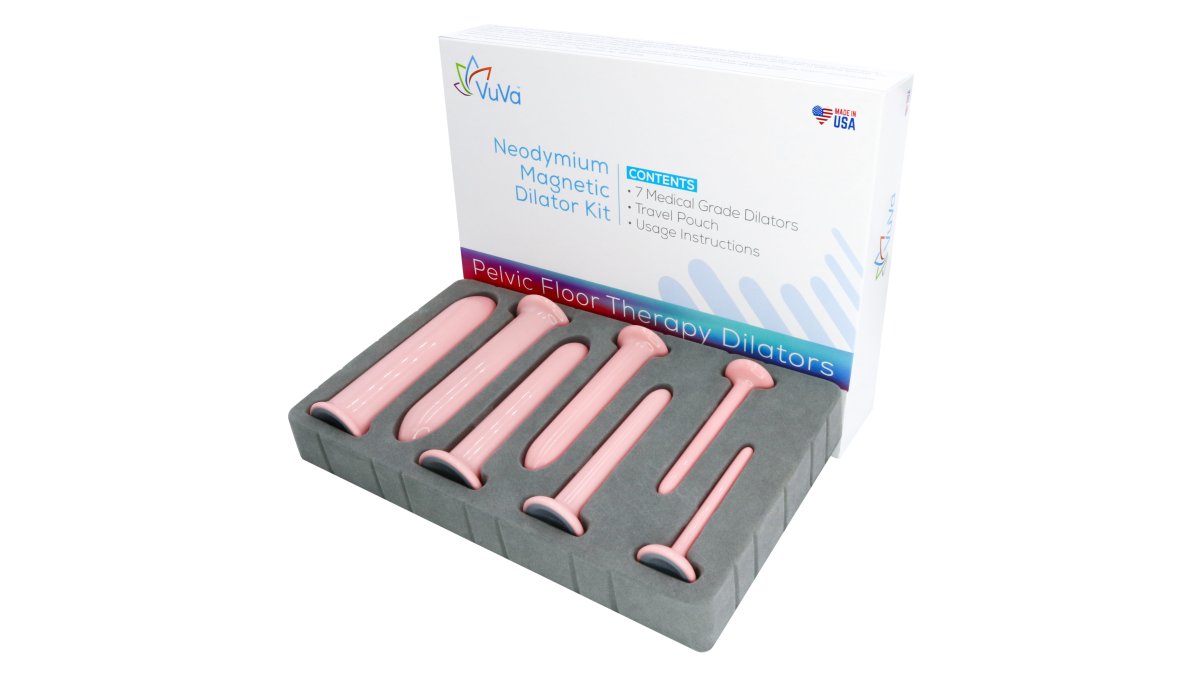
VuVa Magnetic Dilators feature our patented neodymium magnet technology, setting them apart from traditional non-magnetic dilators. Both types support gradual stretching. The difference is the permanently enclosed neodymium magnets built into each dilator, which are part of the design I patented.
How to choose your set:
VuVa Full Magnetic Set - Best Seller →
- Start smaller than you think. Most women begin with the smallest size, even if it seems too small.
- Buy a set, not a single dilator. Progress happens in small steps, and having the next size ready keeps momentum.
- Check the sizing. Our VuVa Full Magnetic Set runs from a 0.375-inch diameter up to 1.625 inches across seven sizes.
- Use lubricant. A water-based gel makes insertion easier and reduces friction.
If you are unsure where to begin, explore the VuVa Magnetic Dilator Collection and start with the set that matches your comfort level.

When to Seek Medical Advice, and What a First Appointment May Involve
Book an appointment if penetration pain is persistent, if you notice unexplained bleeding, or if you have symptoms of infection such as discharge, fever, or unusual odor. Those signs need evaluation, not a dilator.
One question women frequently ask me is not "I don't want help", it is "I don't know what will happen at the appointment, and I'm scared it will hurt." That fear is legitimate, and it is worth addressing directly, because uncertainty is often worse than the visit itself.
Before the appointment
- Write down your symptoms. When did the pain start? Is it at entry, deeper, or both? Does it happen with tampons, fingers, exams, or only during sex? Does anything make it better or worse?
- Note your history. Prior infections, surgeries, childbirth, menopause status, and any history of pain with penetration all matter.
- Choose the right clinician. A gynecologist, a pelvic floor physical therapist, or a vulvovaginal specialist are all reasonable starting points. It is okay to call ahead and ask whether the practice has experience with painful penetration.
- Bring a support person if it helps. You are allowed to have someone in the room with you.
What the appointment may involve
A good first appointment usually starts with a conversation, not an exam. Your clinician should ask about your history, when the pain started, and what it feels like. You can decline a physical exam at any point, and you can ask to stop at any moment, consent is ongoing, not a one-time yes.
If you agree to an exam, a gentle clinician often starts by looking at the external genital area only, and proceeds slowly and only as you feel able.
After the appointment
You should leave with a clearer sense of what may be going on and what the next steps are. If you feel dismissed, rushed, or pressured, it is reasonable to seek a second opinion. A healthcare professional who listens is the one you want on your team.
Once a clinician has confirmed that muscle guarding or vaginismus is part of your picture, gradual stretching with dilators is one possible part of a broader care plan, alongside pelvic floor physical therapy, relaxation work, and counseling where appropriate. VuVa Magnetic Dilators feature our patented neodymium magnet technology, setting them apart from traditional non-magnetic dilators, and they are designed to support a slow, comfortable stretching routine at home, always as part of a plan you build with your care team, not in place of one.
Frequently Asked Questions
Can vaginismus feel like hitting a wall during penetration?
Yes, that is one of the most common descriptions. Many women say penetration stops abruptly, as if something solid is blocking the way, even when nothing physical is there. The sensation comes from the pelvic floor muscles clamping down involuntarily at the vaginal opening. It can feel like pressure, a blocking sensation, or a hard stop rather than a stretch. Some women describe it as a clamping or closing feeling the moment anything tries to enter. If this sounds familiar, a pelvic floor physical therapist or gynecologist can help you understand what is happening and what to try next.
Can vaginismus make tampon insertion painful?
It can. Tampon insertion is often one of the first signs, especially for teenagers or women who have never been able to use them comfortably. The same involuntary tightening that affects sex can make a tampon feel too large, cause burning or stinging at the opening, or make insertion impossible. Some women find they can insert a tampon on lighter days but not on heavier ones, or only at certain angles. If tampons consistently hurt, that is worth mentioning to a healthcare professional rather than pushing through the pain.
How is vaginismus diagnosed, and do I need a pelvic exam?
There is no single lab test for vaginismus. Diagnosis usually comes from a conversation about your history and symptoms, sometimes combined with a gentle pelvic examination. A clinician may ask about pain with penetration, tampon use, and anxiety around intimacy, and may check for involuntary tightening of the pelvic floor muscles. You can ask to pause, use a smaller speculum, or stop the exam at any point. If you are nervous, it is reasonable to say so beforehand. Some clinicians will diagnose based on history alone if an exam would be too painful.
Are vaginal dilators for vaginismus safe to use at home?
Dilators are widely used as part of vaginismus treatment, often alongside pelvic floor physical therapy, and many women use them at home. The key is going slowly and never forcing past pain. Start with the smallest size that feels manageable, use plenty of lubricant, and stop if pain increases. VuVa Magnetic Dilators are designed for gradual stretching and include permanently enclosed neodymium magnets as a design feature, which sets them apart from traditional non-magnetic dilators. Dilators are one part of a broader care plan, so check with your clinician before starting, especially if you have unexplained pain or bleeding.


