


Table of Contents
- What Vaginismus Treatment at Home Actually Looks Like in 2026
- Pelvic Floor Physical Therapy Techniques You Can Do at Home
- How to Use Vaginal Dilators for Beginners
- Magnetic vs Non-Magnetic Dilators: What's Actually Different
- Choosing the Right Dilator Set for Your Body and Your Budget
- Your Vaginismus Recovery Timeline: What Progress Really Looks Like
- Partner Support, Counseling, and Mental Health Tools That Help
- Conclusion
- Frequently Asked Questions
Last Updated: October 21, 2026
What Vaginismus Treatment at Home Actually Looks Like in 2026
When I invented VuVa, I wanted women to have another option. I'd spent years with vulvodynia, and I knew how exhausting it is to be told to "just relax" when your body has other plans. If you're searching for vaginismus treatment options at home in 2026, here's the honest picture: the most effective home routines combine gradual stretching, breathing work, and emotional support, and a 2026 systematic review in PubMed's vaginismus treatment meta-analysis reported pooled success rates of 86% for combined psychosexual interventions and 82% for cognitive behavioral therapy.
Vaginismus is an involuntary contraction of the pelvic floor muscles that makes penetration painful or impossible, often reinforced by a fear-pain cycle.
Why the Fear-Pain Cycle Keeps Penetration Pain Going
The fear-pain cycle works like this: you anticipate pain, your pelvic floor muscles tense involuntarily, penetration hurts, and the next attempt feels scarier. Breaking that loop is the whole game. A 2025 review in the Journal of Osteopathic Medicine on emerging vaginismus treatments found most studied approaches were multimodal, combining pelvic floor physical therapy, CBT, and other care rather than a single exercise.
Pelvic Floor Physical Therapy Techniques You Can Do at Home
Pelvic floor physical therapy techniques translate well to home practice, but they work best alongside professional guidance. A pelvic floor PT can assess whether your muscles are overactive, underactive, or coordinating poorly, which shapes your home exercises. Here's the general foundation most practitioners start with.
Diaphragmatic Breathing and Relaxation Techniques
Diaphragmatic breathing is the foundation of everything else. When you breathe into your belly rather than your chest, the diaphragm descends and the pelvic floor gently lengthens, the opposite of the bracing pattern many women with vaginismus have learned.
Here is how I teach it:
- Lie on your back with knees bent, or sit comfortably if lying down feels vulnerable.
- Place one hand on your belly and one on your chest.
- Inhale through your nose for a slow count of four, letting the belly hand rise while the chest hand stays relatively still.
- Exhale slowly for a count of six, letting the belly fall.
- Repeat for five to ten minutes. Once daily, consistently, beats an hour once a week.
Pair this with progressive muscle relaxation: tense each muscle group for about five seconds, then release for ten, working from your feet up to your face. The point is to relearn the difference between tension and release.
Manual Release and Vulvar Desensitization Methods
Manual release means gentle, sustained pressure on tight pelvic floor trigger points. A pelvic floor PT can locate these for you; at home, work on what you can comfortably reach with a clean finger and water-based lubricant.
Vulvar desensitization is a separate, gentler practice: gradually expand the area of the vulva you can tolerate being touched without pain or fear.
A few practical notes:
- Trim your nails and wash your hands before any manual work.
- Use a mirror the first few times so you can see what you are doing and connect visually with the area.
- Keep sessions short, five to ten minutes, and stop while you still feel calm rather than waiting until you are overwhelmed.
Where Dilators Fit Into the Home Routine
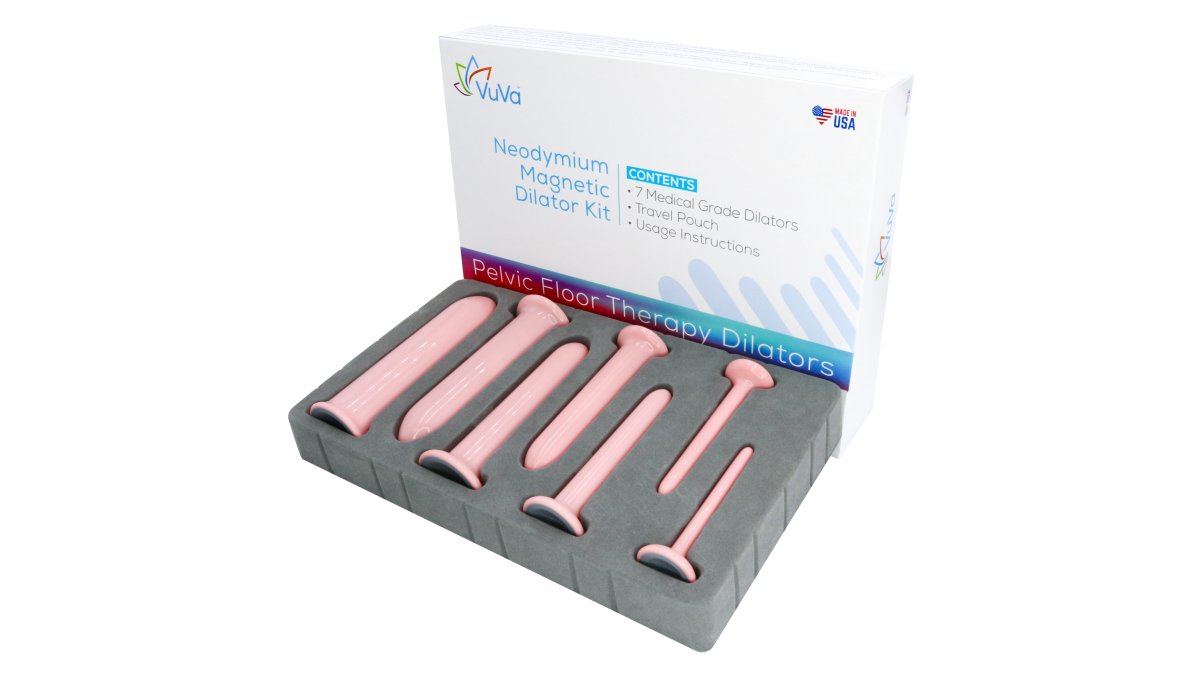
Once breathing and gentle desensitization feel manageable, graduated dilation is the next step for many women. This is where VuVa Magnetic Dilators come in.
To be clear: the stretching benefit of dilator therapy is well documented, but we do not claim the magnets are clinically proven to outperform non-magnetic dilators. Our magnetic design is a genuine difference, not a marketing label.
VuVa Full Magnetic Set - Best Seller →
If you are just starting and penetration feels frightening, the VuVa Neodymium Magnetic Set - Sizes 1,2,3,4 is the gentlest entry point. If you can insert a tampon with ease but intercourse is uncomfortable, the VuVa Neodymium Magnetic Set - Sizes 3,4,5,6 is the most common starting place. And if you would rather have every size on hand, the VuVa Full Magnetic Set covers sizes 1 through 7.


How to Use Vaginal Dilators for Beginners
Vaginal dilators are smooth, graduated inserts used to gently stretch tissue and reduce penetration pain over time. For beginners, the rule is simple: start smaller than you think you need and never push through sharp pain.
- Set aside 10-15 minutes in a calm space, with no deadline.
- Empty your bladder and wash your hands.
- Apply generous water-based lubrication to the dilator.
- Breathe out slowly as you insert, stopping at the first sign of sharp pain.
- Leave it in place for a few minutes, then remove gently.
Magnetic vs Non-Magnetic Dilators: What's Actually Different
Both magnetic and non-magnetic dilators provide mechanical stretching, and both can support a gradual routine. The difference is design. VuVa Magnetic Dilators feature our patented neodymium magnet technology, permanently enclosed within each dilator, setting them apart from traditional non-magnetic dilators.
| Feature | VuVa Magnetic Dilators | Conventional Non-Magnetic Dilators |
|---|---|---|
| Stretching mechanism | Graduated sizing | Graduated sizing |
| Magnet technology | Permanently enclosed neodymium magnets | None |
| Patent status | Patented design (US Patent 9,687,274) | Varies |
| Material | Medical-grade BPA-free plastic | Varies |
| Made in | USA | Varies |
To be clear about what's established: the stretching benefit of dilator therapy is well documented, but we don't claim the magnets are clinically proven to outperform non-magnetic dilators.
Choosing the Right Dilator Set for Your Body and Your Budget
Choosing a set comes down to where you're starting, not where you hope to end up. If penetration feels frightening and even a tampon is difficult, begin with the VuVa Neodymium Magnetic Set - Sizes 1,2,3,4. If you can insert a tampon with ease and are sexually active but uncomfortable, the VuVa Neodymium Magnetic Set - Sizes 3,4,5,6 is the most popular starting point. If you'd rather have every size on hand, the VuVa Full Magnetic Set covers sizes 1 through 7.
Your Vaginismus Recovery Timeline: What Progress Really Looks Like
Recovery timelines vary widely, and anyone who gives you a fixed number of weeks is guessing. A 2026 analysis notes that outcomes shift significantly depending on which modalities you combine, such as pairing a dilator protocol with psychological support (Fertilia's dilator protocol analysis). What I tell women is to expect weeks, not days, and to measure progress by tolerance rather than by calendar.
Tracking Progress Without Fixating on Numbers
Keep a simple log: date, dilator size, minutes held, pain level from 1 to 10, and one word for how you felt. Review it monthly, not daily. The pattern matters more than any single session, and a bad day after a stressful week is data, not failure.
Partner Support, Counseling, and Mental Health Tools That Help
Partner support and mental health care are not extras; they are part of the treatment. Here's something more usable than "talk to your partner," because the emotional side of vaginismus is where the fear-pain cycle lives.
Partner-Inclusive Home Exercises
A partner who understands the goal can help rather than accidentally add pressure. A few low-stakes practices many couples find useful:
- Sensate focus, non-genital version. Set a timer for ten minutes. One partner touches the other's hands, arms, or back with no goal beyond noticing sensation. No intercourse, no expectation. Then switch. This rebuilds trust that touch does not have to lead anywhere painful.
- The "pause word." Agree on a neutral word that means stop immediately, no explanation needed in the moment. Knowing it exists often reduces anxiety enough that couples rarely need to use it.
- Shared breathing. Sit facing each other or side by side and breathe slowly together for five minutes. Coordinated breathing lowers arousal levels in both people and signals safety.
Research from Brigham Young University on partner support in vaginismus treatment examines how partners can better understand and support someone with vaginismus, and that understanding changes the emotional climate around intimacy. The pattern I hear most often is that when partners stop treating penetration as the finish line, the fear-pain cycle loosens.
Counseling and Psychological Support
Cognitive behavioral therapy directly targets the fear-pain cycle by helping you notice the thought ("this will hurt"), the body response (bracing), and the behavior (avoidance), and then practice a different response. A 2026 systematic review in PubMed's vaginismus treatment meta-analysis reported pooled success rates of 86% for combined psychosexual interventions and 82% for cognitive behavioral therapy, which is a strong argument for not doing this alone.
Emotional Regulation Tools Between Sessions
These are the tools I wish someone had handed me earlier:
VuVa Full Magnetic Set - Best Seller →
- Somatic tracking. Close your eyes and scan from head to toe, noticing sensation without trying to change it. When you find tension, breathe toward it rather than away. Five minutes is enough.
- Mindfulness-based stress reduction (MBSR) basics. A body scan, a slow walk with attention on the feet, or a guided breathing recording. The goal is practice at noticing without judgment, not relaxation as a performance.
- Journaling with a specific prompt. Not "how do I feel" but "what did my body do right before I felt afraid today." Patterns emerge fast.
If you are dealing with this, I want you to know there are options worth exploring, and none of them require you to white-knuckle your way through pain.
Where Magnetic Dilators Fit Alongside Emotional Work
Emotional tools and physical tools work best together. VuVa Magnetic Dilators feature our patented neodymium magnet technology, setting them apart from traditional non-magnetic dilators. Both magnetic and non-magnetic dilators provide mechanical stretching, but VuVa pairs that stretching with permanently enclosed neodymium magnets as an additional design feature.
When you are ready to choose a set, start where your body is now, not where you hope to be. If penetration currently feels frightening, begin with the VuVa Neodymium Magnetic Set - Sizes 1,2,3,4. If you can insert a tampon comfortably but intercourse is painful, the VuVa Neodymium Magnetic Set - Sizes 3,4,5,6 is the most popular starting point. If you want every size available, the VuVa Full Magnetic Set covers sizes 1 through 7.
Conclusion
The hardest part of vaginismus treatment at home isn't the dilator. It's believing your body can change, and giving it consistent, gentle evidence that it can. If you're ready to start, explore VuVa Magnetic Dilators and find your starting size, or begin with the Sizes 1,2,3,4 set if penetration currently feels frightening. Our patented neodymium design, medical-grade materials, and discreet shipping make starting at home feel less intimidating.
References & Further Reading
- PubMed, "Vaginismus treatment: a systematic review and meta-analysis," 2025/2026. PubMed systematic review
- Journal of Osteopathic Medicine, "Emerging treatment options for vaginismus: a comprehensive review of current evidence and future directions," 2025. JOM abstract
- Brigham Young University ScholarsArchive, "The impact of partner support on vaginismus treatment." BYU ScholarsArchive record
- Cleveland Clinic, "Vaginismus: Causes, Symptoms, Diagnosis & Treatment." Cleveland Clinic vaginismus overview
- NHS, "Vaginismus." NHS vaginismus guidance
Frequently Asked Questions
What are the most effective at-home treatments for vaginismus?
At-home vaginismus treatment usually combines several approaches rather than one. A systematic review and meta-analysis indexed on PubMed reported a pooled therapeutic success rate of 86% for combined psychosexual interventions and 82% for cognitive behavioral therapy. In practice, that means pairing gradual dilation or stretching with pelvic floor relaxation work, breathing exercises, and psychological support. Home exercises are not a complete treatment on their own, so it is worth having a pelvic floor physical therapist or doctor involved, especially if pain is persistent or you have symptoms like bleeding or irritation.
How do magnetic dilators differ from traditional dilators?
Both magnetic and non-magnetic dilators are used for gradual stretching, so the physical routine is similar. The difference is design: VuVa Magnetic Dilators contain permanently enclosed neodymium magnets and feature our patented magnetic technology, while conventional dilators provide mechanical stretching without integrated magnets. I want to be clear that we do not claim the magnets are clinically proven to work better than non-magnetic dilators, because that direct comparison has not been established in clinical research. What I can say is that the magnetic design is a real, patented difference in how the product is built.
Can I treat vaginismus on my own at home?
Many women do make meaningful progress with home routines, and a review notes that comprehensive protocols including pelvic floor physical therapy and home-based dilator therapy report success rates in the 80% to 90% range. That said, home work is one part of a broader care plan, not a replacement for evaluation. If you have unexplained pain, bleeding, infection symptoms, or irritation that does not settle, see a clinician before continuing. A pelvic floor physical therapist can also check your technique and make sure you are not reinforcing muscle tension.
How do I choose the right size dilator for my needs?
Start with the smallest size you can insert without bracing or pain, and size up only when the current one feels comfortable and unremarkable. If you can insert a tampon with ease, a mid-range set is often a reasonable starting point; if penetration feels impossible or exams are uncomfortable, begin with the smallest sizes. VuVa's Size 1-2-3-4 set is built for that gradual start, while the Size 3-4-5-6 set suits women who are already sexually active but uncomfortable. Graduated sizing matters more than speed.
What role does pelvic floor relaxation play in managing vaginismus?
A large part of vaginismus is involuntary muscle contraction, so relaxation work is not optional extras, it is central. Diaphragmatic breathing, body awareness practice, and gentle manual release help interrupt the fear-pain cycle that keeps pelvic floor muscles tight. Clinical sources describe treatment as multimodal, combining pelvic floor physical therapy, cognitive behavioral therapy, and other approaches rather than a single exercise. Practicing relaxation before any dilation or stretching session makes the physical work easier and less painful.
How long does vaginismus recovery usually take?
There is no single timeline, and anyone who gives you an exact number is guessing. What the research does show is that outcomes vary significantly depending on which modalities are combined, such as dilator protocols paired with psychological support. In practice, many women notice the first changes in comfort within weeks, while fuller progress with penetration often takes several months of consistent practice. Tracking small markers, like breathing more easily during insertion or moving up a size without bracing, gives you a clearer picture than a calendar does.
Do I need to buy a full dilator set or can I start with one?
You can start small, and I would rather you did than buy everything at once and feel overwhelmed. VuVa's Size 1-2-3-4 set covers the first four graduated sizes, which is usually enough for the early weeks of a stretching routine. If you can already insert a tampon comfortably, the Size 3-4-5-6 set is the more common starting point. The full set of seven sizes makes sense if you want one purchase that covers the whole progression. Choose based on where you are now, not where you hope to be.


