


Last Updated: November 14, 2026
Quick Summary
P2 meaning in automotive diagnostics: P2 is the first character of an OBD-II trouble code that identifies a powertrain fault in the engine, transmission, or drivetrain. The full five-character code, such as P2187, shows the specific fault and should be checked against the manufacturer's documentation for your vehicle.
- The first letter P stands for powertrain; the second character shows whether the code is generic or manufacturer-specific.
- Many P2 codes are manufacturer-specific, so the same code can mean different faults on different makes.
- Record the full code and freeze-frame data before clearing anything, since those conditions help diagnose the fault.
- Clearing codes without fixing the cause can hide intermittent faults and reset emissions readiness monitors.
- A flashing check engine light or heavy power loss means stop driving and get professional diagnostics.
Table of Contents
- What P2 Means in Automotive Diagnostics
- How to Read an OBD-II Code, Character by Character
- Generic vs Manufacturer-Specific OBD-II Codes
- P2xxx Code Meaning: Common Fuel, Air and Emissions Faults
- Diagnostic Steps for Engine-Related P2 Codes
- UDS P2 and P2* Timing: A Different Meaning of P2
- Booking Professional Diagnostics for Your P2 Code
- Frequently Asked Questions
What P2 Means in Automotive Diagnostics
P2 is the first character of an OBD-II diagnostic trouble code, and it identifies the code as a powertrain fault, which is the core of the P2 meaning in automotive diagnostics. In automotive diagnostics, a P2 code points to a problem in the engine, transmission, or related drivetrain systems that the vehicle's computer has detected and stored. The full code, such as P2187, tells a technician more than the letter alone, which is why the complete string matters.
The word "P2" also appears in a completely different context, and that is where much of the confusion starts. In the Unified Diagnostic Services (UDS) standard used inside vehicle electronics, "P2" refers to a response timing parameter, not a trouble code. Both meanings are covered below so you can tell which one applies to what you are looking at.
This guide explains what a P2 code tells you, how to read its structure, and what to do next. The information is general. A diagnosis for a specific vehicle depends on that vehicle's data and, in many cases, professional equipment.
How to Read an OBD-II Code, Character by Character
An OBD-II code is five characters long, and each position carries a specific meaning. Understanding the structure lets you read the code before you look anything up.
- First character (letter): The system group. P means powertrain, B means body, C means chassis, and U means network communication.
- Second character (number): Whether the code is generic or manufacturer-specific. A 0 indicates a generic code defined by the SAE standard, and a 1, 2, or 3 indicates a manufacturer-specific code.
- Third character (number): The subsystem. For example, 1 is typically fuel and air metering, 2 is fuel and air metering (injector circuit), 3 is ignition system, and 4 is auxiliary emissions controls.
- Fourth and fifth characters: The specific fault within that subsystem, such as a particular sensor or circuit.
Reading P2187 this way gives you: P (powertrain), 2 (manufacturer-specific, or a generic code in some ranges), 1 (fuel and air metering), and 87 (the specific fault). This decoding is a starting point. The exact fault description still has to be confirmed against the manufacturer's documentation for your vehicle.
Generic vs Manufacturer-Specific OBD-II Codes
Generic codes follow a standard definition set by the Society of Automotive Engineers, so a P0 code generally means the same fault across makes. Manufacturer-specific codes, which begin with P1, P2, or P3 in their second position, are defined by each automaker and can mean different things on different vehicles.
This is the main reason P2 codes need care. A P2 code is often manufacturer-specific, so the same five-character string may describe a different fault on a Ford than on a Toyota. Always check the code against the documentation for the exact make, model, and year before deciding on a repair.
P2xxx Code Meaning: Common Fuel, Air and Emissions Faults
Many P2xxx codes relate to the systems that control how fuel and air mix and how exhaust is treated. Two groups come up most often.
Fuel and Air Metering Faults
Codes in the P2100 to P2199 range commonly involve the throttle body, the mass airflow or manifold pressure sensors, and fuel injector circuits. A fault here can make the engine run rough, lose power, or stall, because the computer is not receiving accurate information about how much air is entering the engine.
Emissions-Control System Faults
Some P2xxx codes point to problems with the exhaust and emissions equipment, including oxygen sensors and catalytic converter efficiency. These faults often turn on the check engine light without a noticeable change in how the car drives, so the light may be the only warning.
The article groups many P2xxx codes by the system they involve, so you can see at a glance where a fault is most likely to sit.
| Code range | Common system involved | Typical effect |
|---|---|---|
| P2100-P2199 | Throttle body, airflow or manifold pressure sensors, injector circuits | Rough running, lost power, stalling |
| P2200-P2299 | Oxygen sensors, NOx sensors, aftertreatment | Check engine light, often no obvious driving change |
| P2300-P2399 | Ignition coils, misfire detection | Misfire-related symptoms |
Diagnostic Steps for Engine-Related P2 Codes
A P2xxx code is a starting point, not a diagnosis. The prefix tells you the fault is in the powertrain group and that the second character is 2, which usually means the code is manufacturer-controlled rather than a generic SAE definition. That single fact changes the workflow: you cannot rely on a generic code chart, and you must confirm the definition against the documentation for the exact make, model, year, and engine.
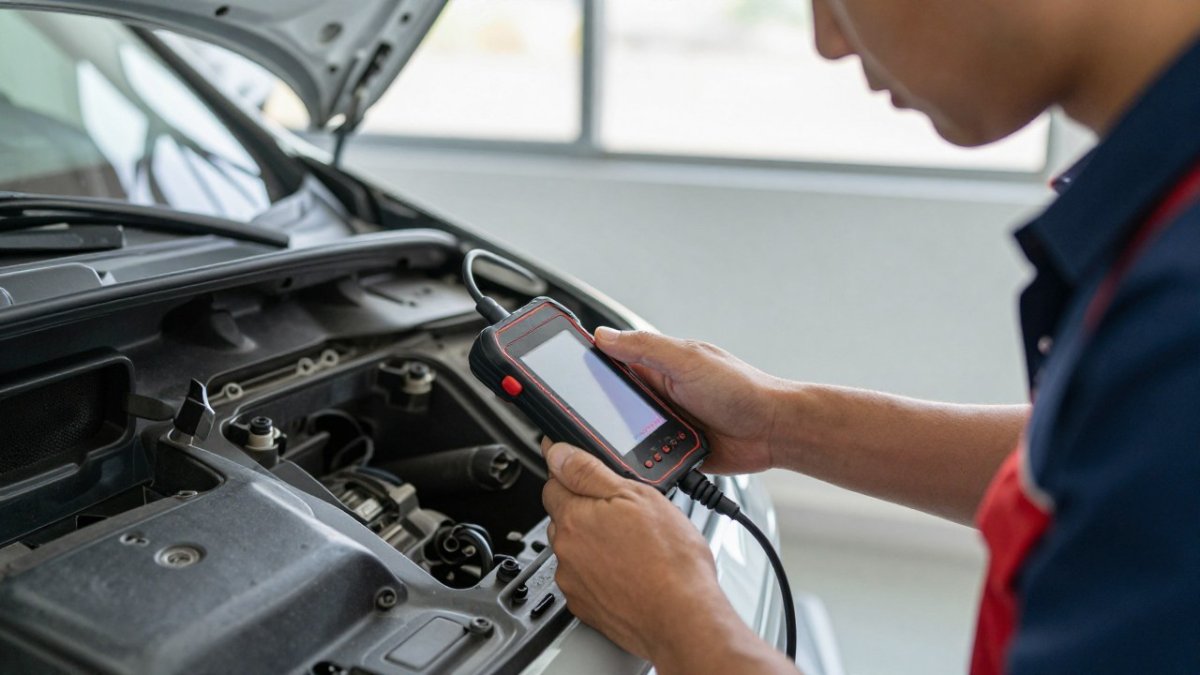
A structured approach avoids replacing parts that are not at fault.
- Record the full code and freeze-frame data. Write down the exact five-character code, plus the engine speed, load, coolant temperature, intake air temperature, and short/long-term fuel trim captured at the moment the fault set. Freeze-frame is often more useful than the code itself because it shows the conditions that triggered it.
- Check for related and pending codes. A single root cause frequently sets several codes. Note which code is stored, which is pending, and which is permanent. The first code stored is not always the root cause, and a pending code that has not yet matured can point to an intermittent fault.
- Confirm the code definition for your vehicle. Look up the code in the manufacturer's service information, not a generic online list. The same P2xxx string can describe different faults on different makes, and even within one make across model years.
- Inspect the wiring and connectors for the affected circuit. Look for loose plugs, corrosion, chafed wires, heat damage, and rodent damage. A circuit fault can mimic a failed sensor.
- Test the sensor or component against the manufacturer's specified values. Use a multimeter or a scan tool with live data. Compare actual readings to the specification rather than to a guess.
- Clear the code and retest under the same conditions. If the fault returns quickly under the freeze-frame conditions, the problem is likely still present. If it does not return, treat it as intermittent and monitor.
Watch out: Clearing codes without fixing the cause can hide an intermittent fault, reset emissions readiness monitors, and make later diagnosis harder. On some vehicles, clearing codes also wipes adaptive learning values that take time to relearn.
P2xxx codes cluster around a few system families. Codes in the P2100-P2199 range commonly involve the throttle body, accelerator pedal position sensors, mass airflow and manifold pressure sensors, and fuel injector circuits. Codes in the P2200-P2299 range often involve oxygen sensors, NOx sensors, and emissions aftertreatment. Codes in the P2300-P2399 range frequently involve ignition coils and misfire detection. These ranges are general patterns, not guarantees, the manufacturer's definition always wins.
If the check engine light is flashing, the engine is losing significant power or stalling, or the code keeps returning after a repair, stop driving and get professional diagnostics. A flashing light can indicate a misfire severe enough to damage the catalytic converter.
UDS P2 and P2* Timing: A Different Meaning of P2
In UDS diagnostic communication, P2 and P2* are timing parameters, not trouble codes. They live in the diagnostic protocol layer (ISO 14229) that governs how a tester and an ECU talk to each other, and they answer a simple question: how long is the tester willing to wait for an answer?
P2 is the base response time. After the tester sends a request, the ECU has P2 milliseconds to begin sending a response. P2* is the extended response time. If the ECU cannot finish the job inside P2, it sends a negative response with the code 0x78 (responsePending), and the tester then waits up to P2* milliseconds for the final answer. P2* is typically much longer than P2 because it covers operations like erasing a flash block or running a routine that genuinely takes time.
A request-response timeline makes this concrete:
- Tester sends a request at time 0.
- ECU must start responding within P2 (commonly in the 50 ms range, though the exact value is set by the ECU's diagnostic specification).
- If the ECU needs more time, it sends 0x78 responsePending before P2 expires.
- The tester resets its timer and now waits up to P2* (often in the low thousands of milliseconds) for the final positive or negative response.
- If no response arrives within the applicable window, the tester reports a timeout, not a trouble code.
This distinction matters because a P2 timeout and a P2xxx trouble code are unrelated. A timeout means the tester did not hear back from the ECU in time, which points to a communication, wiring, power, or configuration problem. A P2xxx code is a stored powertrain fault the ECU itself set. If you saw "P2" in a tester configuration file, a diagnostic script, or a CANoe/CAPL session, it is almost certainly the timing parameter. If you saw it as the first two characters of a five-character code on a scan tool, it is a trouble code.
Watch out: P2 and P2* values are not universal constants. They are defined by the applicable diagnostic standard and by the individual ECU's diagnostic description, so a value that works on one module can cause false timeouts on another. Always pull the timing from the specification for the exact ECU you are testing rather than assuming a default.
Booking Professional Diagnostics for Your P2 Code
Reading a P2 code is a useful first step, but many P2 faults need professional equipment and experience to resolve. Live data, oscilloscope testing, and manufacturer-specific procedures are often required to confirm the true cause, particularly for intermittent faults and for codes that are specific to one make.
Frequently Asked Questions
What does P2 mean in automotive diagnostics?
In OBD-II diagnostics, the P in a code means powertrain, covering the engine, transmission and related emissions systems. The second character, 2, indicates a fuel or air metering or auxiliary emissions-control fault, and the remaining digits pinpoint the specific circuit or system. Because P2 is one code family, the exact meaning depends on the full code, such as P2xxx. Check the complete code and your vehicle manufacturer's service information to confirm what the fault refers to.
Are P2 codes generic or manufacturer-specific?
Codes in the P0 range are generic and standardized under SAE rules, so the same code means the same thing across makes. Codes beginning with P1, and many P2 codes, are manufacturer-specific, which means the meaning can vary between brands and models. For a P2 code, look up the full code with the vehicle make, model and year to find the correct description and repair information.
Can I drive with a P2 code?
Some P2 codes cause only minor drivability changes, while others point to faults that can affect emissions, fuel economy or engine performance. Whether it is safe to keep driving depends on the specific code, any warning lights and how the vehicle behaves. If the check engine light is flashing, the engine runs roughly, or you notice overheating or loss of power, stop driving and have the vehicle inspected by a qualified technician.
What is the difference between a P2 code and a UDS P2 timer?
A P2 code is a diagnostic trouble code stored by the vehicle's OBD-II system to describe a fault. A UDS P2 timer is a time value used in Unified Diagnostic Services communication to define how long a diagnostic tester should wait for an ECU response. The two share a letter but belong to different systems, so the context of your work tells you which one applies.


